.png)
The Power of Imagery in Movement

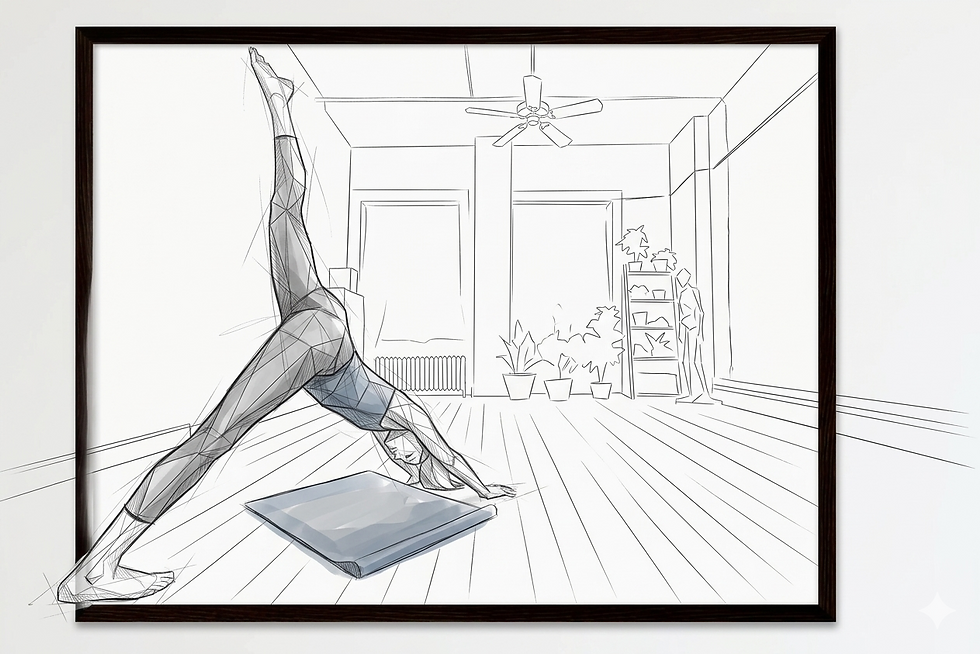
Using imagery in movement is not something new, nor is it unique to one practice or teaching method. Long before I began teaching movement, imagery was already woven into dance, yoga, somatic practices, athletics, and storytelling traditions across cultures.
When I taught children’s ballet, imagination was often the bridge that created engagement. Children instinctively understand imagery. Ask them to become wind, water, or birds, and suddenly the movement comes alive. There is less overthinking and more embodiment.
As we grow older and become more technically trained, that natural imagination can sometimes grow quieter. Technical proficiency and body awareness are essential, especially for dancers and movement practitioners, but they can also create tension or self-consciousness when movement becomes overly analytical. I remember having a conversation with a friend about artistry versus technical virtuosity, and she shared a quote by Martha Graham that stayed with me: “Great dancers are not great because of their technique, they are great because of their passion.” Passion and imagination are deeply connected. Imagination allows movement to become expressive rather than mechanical; it brings emotion, curiosity, texture, and life into the body. Technique gives us structure and clarity, but imagination gives movement depth and humanity. Maturity may bring greater awareness of the body, yet true embodiment often requires reconnecting with the creativity and instinctive freedom we moved with so naturally as children.
When I teach movement, I often return to imagery as a guide. Imagery can provide direction, sensation, rhythm, quality, and emotional tone all at once. A well-placed image can instantly change the way someone organizes their body without forcing or over-correcting.
This made me think about yoga asanas and the Sanskrit origins of their names. Most yoga pose names are direct translations or descriptions of the original Sanskrit. For example, Vrksasana translates to “Tree Pose,” while Bhujangasana translates to “Cobra Pose.” These names are not arbitrary; they embody the shape, quality, energy, or essence of the pose itself. The image becomes part of the movement experience. You are not only arranging the body mechanically you are inhabiting an idea, an atmosphere, or a living form.
I often think about this in my own movement practice and in the classes I take. In a class with Debra Rose, we once explored what the roundest shape we could make in Gyrokinesis® might feel like. She brought in the image of a puffer fish, explaining how it expands outward through its accordion-like body, inflating to many times its original size. Now, whenever I move into a curled diamond shape, I think of that puffer fish. Instead of gripping or compressing, the image helps me soften tension and expand into my back body with more ease and breath.
Similarly, in Yoga Narada® classes with Hilary, imagery is often used with the breathwork: sipping a sweet elixir, drawing breath through a straw, or drinking the final drops from the bottom of a cup. These images immediately create sensation. We understand them instinctively because they relate to lived experience. The body responds before the intellect has time to analyze.
What fascinates me most is that imagery does not bypass the brain it actively engages it. As explored in the paper Mental Imagery: Functional Mechanisms and Clinical Applications, mental imagery functions as a “weak form of perception,” meaning the brain activates many of the same neural pathways during imagined movement and sensation as it does during actual physical experience. Research suggests that imagery activates sensory and motor regions of the brain, strengthens neural pathways related to movement, supports motor learning, and can even influence emotional regulation.
This research helps explain why imagery can be such a powerful tool in movement practices. When we visualize length, fluidity, grounding, expansion, spiraling, or coordinated action, we are not merely thinking abstractly. We are engaging the nervous system in a sensory experience. Imagery deepens proprioception, refines coordination, influences emotional tone, and supports embodiment. It allows movement to become more expressive, efficient, and neurologically integrated.
In many ways, imagery reminds us that movement is not only mechanical. The body responds not just to instruction, but to story, metaphor, memory, sensation, and imagination. Sometimes the right image can unlock a movement more effectively than technical correction ever could.
Perhaps imagination is not something we leave behind in childhood after all. Perhaps it is something we continue returning to not to escape the body, but to enter it more fully.


Comments